
Protocol deviations are a routine part of clinical research.
They occur in approximately one in three enrolled participants and can affect everything from participant safety to data quality.
Wherever you have people and processes, you will have deviations; you cannot run a clinical trial with zero deviations,
This does not mean you have to avoid every deviation, but identifying it early, documenting it properly, and responding in a way that prevents it from happening again.
What Are Protocol Deviations, and Why Do They Matter?
A clinical trial protocol is the blueprint for a research study.
It outlines the eligibility criteria, visit schedules, treatment procedures, safety assessments, and data collection requirements.
A protocol deviation is any departure from the approved plan.
It can range from a missed visit window to the use of an outdated informed consent form or the failure to complete a required assessment.
Protocol deviations matter for two main reasons.
Firstly, participant safety:
Protocols are designed to protect participants. When procedures are not followed, participants may face unnecessary risks or miss important monitoring.
Secondly, Data integrity:
Clinical decisions rely on accurate data. If procedures are missed or poorly documented, the data may become unreliable.
For this reason, ICH E6(R3) requires sponsors and investigators to identify, document, and address deviations before they become recurring issues.
Major vs. Minor Deviations: How to Classify Them Correctly
Not all protocol deviations carry the same level of risk.
Their classification depends on their impact on participant safety, participant rights, and data integrity, not on the nature of the event alone.
Minor deviations are administrative or procedural issues that do not directly affect participant safety or key study outcomes.
Examples include delays in data entry, incomplete non-critical documentation, and filing errors within study records.
While individually minor, a pattern of these deviations is itself a signal worth investigating.
So minor deviations, even though they say it’s minor, are an important trend identifier.
It identifies sites that are prone to common human errors, and it also opens it up for us to understand whether they need additional training or not.”
Major deviations have a direct impact on participant safety, protocol compliance, or data quality.
Examples include
- Administration of an incorrect treatment dose,
- Failure to confirm eligibility before enrollment,
- Missed critical safety assessments, and
- Failure to report serious adverse events.
In many cases, it is the failure to report that creates the risk, not the event itself.
“It’s not just the fact that you had a serious adverse event, it’s the fact that it’s not reported. Whether you as the Principal Investigator, or as the site person, in your judgment, you have addressed the situation, but you’ve not reported it.
If it’s identified later, it becomes a serious breach, because you exposed the patient to an adverse event.” Aizehi Onoigboria, Clinical Research Project Manager/Founder of UCTSS
Critical deviations are serious compliance failures that may compromise participant safety, participant rights, or the credibility of study data.
One of the clearest examples is conducting study procedures before informed consent has been obtained.
Classification should always involve clinical personnel who understand the study objectives and endpoints. The key question here is :
When classifying a deviation, the key question is:
Does this affect participant safety, rights, or the reliability of study results?
What are some common protocol deviations?
- Missed visit windows: These are among the most common. In this kind of deviation, a participant may face transportation challenges, financial constraints, family emergencies, or health issues that might prevent them from attending visits within the required protocol window.
In many cases, these begin as minor deviations but can become major if they affect key endpoints or safety checks. - The “file-and-forget” trap: This is another common issue, particularly among less experienced site teams. A deviation is identified, documented, filed, and forgotten, without anyone asking why it happened in the first place.
When teams focus only on documenting deviations without investigating why they occurred, the same issues tend to resurface, often at the worst possible time. - Poor site conduct or poor study design: Not every recurring deviation is caused by poor site performance. When the same deviation occurs repeatedly across multiple sites on the same protocol, the problem may be the protocol itself rather than site execution.
This distinction matters because some problems require protocol adjustments rather than additional site training. - The documentation culture in clinical research is about being able to file a record and being able to retrieve it effectively, easily, and quickly.
A site that does not document has already failed within its own processes, regardless of how the actual research is conducted.
The CAPA Framework: Corrective Action and Preventive Action
Once a protocol deviation has been identified, the next step is determining how to prevent it from happening again.
This is where the CAPA framework comes in. CAPA stands for Corrective Action and Preventive Action.
It is the structured approach used to investigate deviations, address immediate issues, and reduce the risk of recurrence.
A corrective action addresses the immediate problem, resolving the issue that has already occurred.
A preventive action addresses the underlying cause, improving the process or system so the same problem does not happen again.
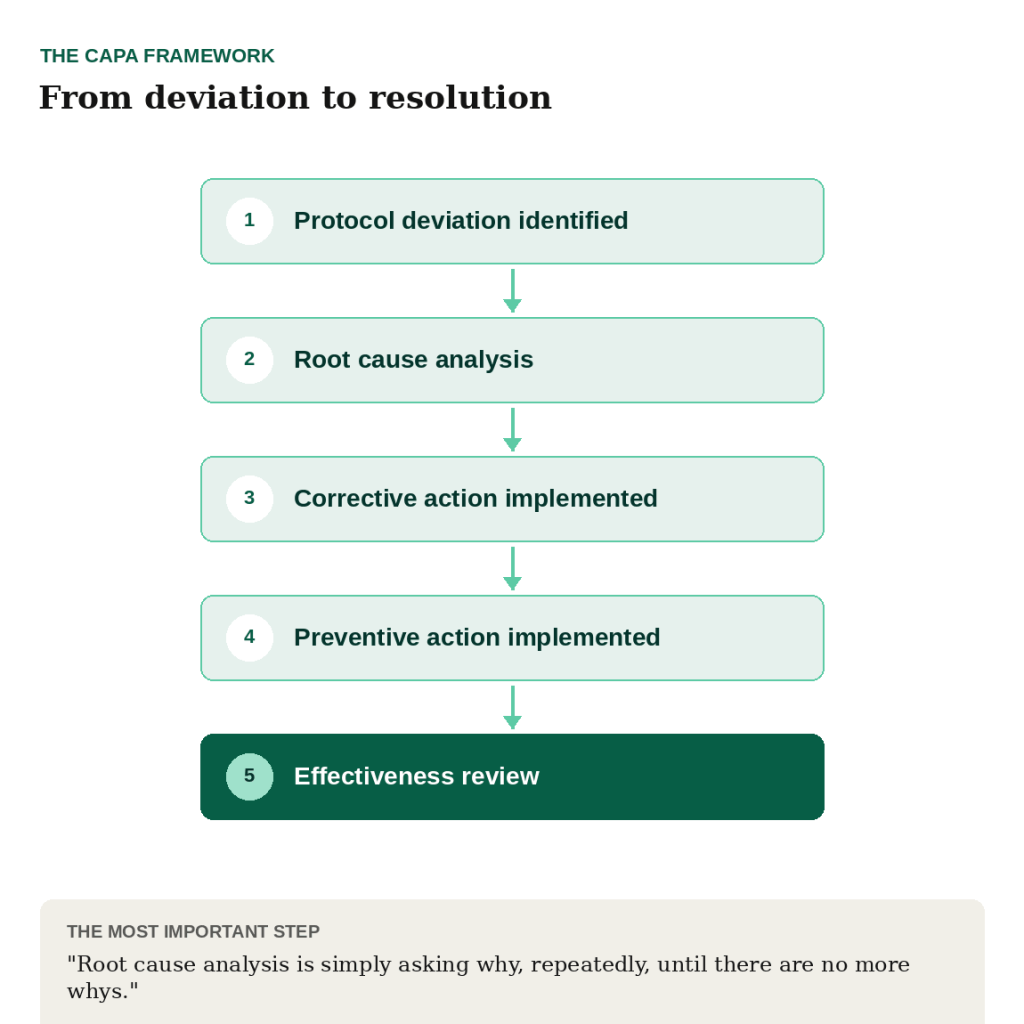
One of the simplest approaches is the 5 Whys method. For example:
- Why was the visit missed?
The participant forgot. - Why did they forget?
No reminder was sent. - Why was no reminder sent?
No one was assigned responsibility for reminder calls. - Why was no one assigned?
Reminder calls were never built into the site’s workflow. - Why was it never built in?
There was no system in place for proactive follow-up
At this point, the issue is no longer participant behaviour. It is a process gap, and an effective CAPA would address that gap directly by assigning responsibility for reminder calls and building the task into routine site operations.
A CAPA that simply states “staff retrained,” without identifying the actual cause, is unlikely to prevent recurrence.
RCA quality determines CAPA quality. A superficial root cause analysis leads to an ineffective CAPA. If you treat the peripheral problem and not the root, the deviation will come back.
The Importance of Documenting Protocol Deviations
Good documentation is one of the strongest indicators of a mature quality system.
The longer the documentation is delayed, the more likely important details will be forgotten or reconstructed inaccurately.
Recording deviations on the day they occur creates a more reliable audit trail and makes investigations easier if questions arise later.
A deviation detected late is ten times more painful than one reported immediately.
When you find it months later, you are writing a root cause analysis from memory, under pressure, with an audit finding hanging over you.
Even a brief contemporaneous note, written the same day, is sometimes more valuable than a detailed report written weeks after the event.
How UCTSS Manages Protocol Deviations Through UCTMS
At United Clinical Trials Support Services, protocol deviation management is built directly into our Clinical Trial Management System, UCTMS.
When a deviation is identified, the system supports a structured workflow that includes deviation logging, risk-based classification, escalation to the appropriate stakeholders, CAPA initiation, CAPA tracking, and effectiveness monitoring.
This approach helps reduce common challenges such as delayed reporting, incomplete investigations, vague CAPAs, and inconsistent escalation practices.
By maintaining a complete digital audit trail from identification through closure, UCTMS provides sponsors and site teams with greater visibility into how deviations are managed throughout the study.
Our procedures are aligned with ICH E6(R3) requirements while taking into account the practical realities of conducting clinical research across Nigeria and West Africa.
What Sponsors Should Look for in a Site’s Deviation Management Process
When assessing a site’s readiness for a clinical trial, sponsors should look beyond the deviation log itself and evaluate how the site manages quality issues in practice.
Six questions are worth asking:
- Is there a clear escalation process that the team has actually practised, not just one written into an SOP?
- Is documentation contemporaneous, or reconstructed after the fact?
- Does the site perform meaningful root cause analysis, or do its CAPAs repeat generic actions like staff retraining?
- Is the deviation log transparent, given that a completely blank log is not necessarily a sign of quality, since in complex studies, some deviations are expected?
- Are deviations identified proactively, before a CRA finds them at a monitoring visit?
- Does the site encourage open reporting, allowing staff to report mistakes without fear of blame?
The strongest sites are not those that have never had a deviation.
They are those who created a culture where reporting is safe.
When teams focus on learning rather than punishment, deviations are identified earlier, and quality improves over time.
Protocol deviations are an inevitable part of clinical research.
The goal is not to eliminate every deviation, but to identify them quickly, assess their impact, and reduce the likelihood of recurrence.
Sites that manage deviations effectively protect participant safety, strengthen data integrity, and build trust with sponsors and regulators.
Partner With UCTSS
Are you preparing for your next study, strengthening site quality systems, or looking for technology-enabled clinical trial support across West Africa,
That is where United Clinical Trials Support Services comes in. Contact us at info@unitedclinicalss.com to learn more about our clinical trial management and site support services.
Add a Comment